Joint Recommendation on Prevention of Vitamin D Deficiency among Infants, Young Children, and Pregnant Women
BACKGROUND
Vitamin D is essential for bone health. Vitamin D helps calcium absorption in the gut, and maintains normal levels of calcium and phosphate in the blood, keeping bones strong. Most of the vitamin D in our body is made when the skin is exposed to sunlight. A small amount of vitamin D comes from foods.
LOCAL SITUATION
A local study1 with fieldwork between 2019 and 2021 was conducted to assess the vitamin D status of infants, young children and pregnant women. The results showed that:
Infants and young children
- The prevalence of vitamin D insufficiency2 and deficiency2 of infants and young children was tabulated as follows:
Infants and young children Prevalence of vitamin D insufficiency Prevalence of vitamin D deficiency Prevalence of vitamin D insufficiency and deficiency 2 - 6 months 19.8% 12.6% 32.4% 7 - 11 months 12.9% 5.1% 18.0% 12 - 23 months 11.3% 0.8% 12.1% - Infants who were breastfed were at higher risk being vitamin D insufficient/deficient while those who had taken a vitamin D supplement or having a higher vitamin D intake from diet were less likely to be vitamin D insufficient/deficient.
Pregnant women
The prevalence of vitamin D insufficiency and deficiency in pregnant women was 9.7% (insufficiency 9.3% and deficiency 0.4%). Those who had taken a multiple micronutrient supplement were less likely to be vitamin D insufficient/deficient.
RECOMMENDATIONS
A multi-disciplinary expert Working Group ("Working Group") comprising representatives from the Department of Health (DH), the Hospital Authority, the Hong Kong Private Hospitals Association, the Hong Kong College of Community Medicine, the Hong Kong College of Family Physicians, the Hong Kong College of Obstetricians and Gynaecologists, the Hong Kong College of Paediatricians, the Hong Kong College of Physicians, the Baby Friendly Hospital Initiatives Hong Kong, and the UNICEF Hong Kong, was established under the Department of Health to formulate joint local recommendations for prevention of vitamin D deficiency among pregnant women, infants and young children. After considering overseas and international guidelines as well as the local situation, the Working Group made the following joint recommendations:
Infants under 12 months
- Healthy infants3 require 400 IU (10 micrograms (μg)) of vitamin D per day irrespective of their mode of feeding.
- Breastfeeding has many benefits and breastmilk is the ideal food for babies. However, breastmilk, similar to all other natural foods, contains only a small amount of vitamin D and may not meet the infant's need for vitamin D.
- To ensure infants maintain sufficient vitamin D level, vitamin D supplementation of 400 IU (10 μg) per day is recommended for all breastfed infants (including exclusively and partially breastfed infants) from birth to 12 months of age4.
- Infants above 6 months of age are recommended to have a variety of vitamin D-rich natural foods such as fatty fish (e.g. salmon, sardine) and eggs in the complementary diet. This can help further boost their dietary intake of vitamin D.
- While sun exposure is the most natural way to obtain vitamin D, infants under 12 months are recommended to be protected from direct sunlight. There is no safe threshold of UV exposure for sufficient vitamin D synthesis without increasing skin cancer risk later in life.
Toddlers and Young children
- Above 1 year of age, young children require 400 to 600 IU (10 to 15 μg) of vitamin D per day.
- Young children are recommended to consume a diet with:
- Vitamin D-rich foods such as fatty fish (e.g. salmon, sardine) and eggs;
- Foods and beverages (e.g. cow's milk, dairy products, soy milk) that are fortified with vitamin D. Vitamin D fortified foods and beverages are readily available in the local market. Parents can identify vitamin D fortified products by reading the information on the food label (including both the list of ingredients and nutrition label).
- Young children are active. They are recommended to participate in physical activities and outdoor play that are suitable for their development and age. Sun exposure during outdoor physical and play activities can increase vitamin D level via endogenous vitamin D synthesis. However, many factors affect the level of vitamin D synthesis. While having outdoor activities, children should follow sun safety practices.
- A daily vitamin D supplementation of 400 IU (10 μg) may be required for children who have risk factors such as having dark skin, having limited sunlight exposure or inadequate dietary intake. Parents are advised to consult healthcare professionals if they have concerns.
Pregnant women
- Pregnant women require 400 to 600 IU (10 to15 μg) of vitamin D per day.
- Pregnant women are advised to take a prenatal multiple micronutrient supplement (containing multivitamins and minerals including vitamin D, iodine, folate, and iron, etc.) throughout the pregnancy. Most of these supplements contain 400 IU (10 μg) of vitamin D which should be adequate to meet most of their vitamin D requirement.
- Pregnant women are recommended to consume a healthy diet and choose vitamin D-rich foods such as fatty fish (e.g. salmon, sardine) and eggs as well as vitamin D fortified (e.g. cow's milk and dairy products) and calcium added beverages (e.g. soy milk).
- Pregnant women are recommended to maintain an active lifestyle with suitable outdoor activities. Sun exposure during outdoor activities increase vitamin D level via endogenous vitamin D synthesis. However, many factors affect the level of vitamin D synthesis. While having outdoor activities, pregnant women should follow sun safety practices.
The Working Group on Prevention of Vitamin D Deficiency among Infants, Young Children and Pregnant Women
August 2025
Remarks:
- IP Patrick, et al. Commissioned Study on Vitamin D Status of Infants, Young Children and Pregnant Women in Hong Kong. Health and Medical Research Fund Reference No.: Vit D-HKU.
- Vitamin D insufficiency and deficiency were defined as serum total 25(OH)D concentration as 25 to <50 nmol/L and <25 nmol/L respectively.
- Some infants may require more than 400 IU (10 μg) of vitamin D per day due to certain medical condition(s) and should follow their doctors' instruction.
- Infant formula and follow up formula milk contain fortified vitamin D.
Frequently asked questions about vitamin D
1. I am breastfeeding and taking a multivitamin containing vitamin D. Does my baby still need vitamin D drops?
- It is a good idea for breastfeeding mothers to take a daily vitamin D supplement to ensure they have sufficient vitamin D themselves.
- All breastfed babies from birth to 12 months should receive a daily vitamin D supplement of 400 IU (10 micrograms), regardless of whether their mother is taking one. This ensures the baby gets enough vitamin D.
2. What are the precautions about taking vitamin D supplements?
- Vitamin D supplements are safe when taken in the amount advised by healthcare professionals. If you consider giving your child a vitamin D supplement, it is essential to consult a healthcare professional and follow the instructions on the drug or dispensary label before giving it to your child.
- Various health authorities have set the Tolerable Upper Intake Level (UL) for vitamin D, which means the highest level of chronic daily nutrient intake that is likely to pose no risk of adverse health effects for almost all individuals in the general population. As intake increases above the UL, the risk of adverse effects increases.
- The Chinese Nutrition Society sets the UL of vitamin D for children aged 0 to 3 at 800 IU (20 micrograms) per day1. A higher UL of vitamin D is recommended in the US and Europe: UL for infants aged 0 to 6 months is 1000 IU (25 micrograms) per day, and UL for infants aged 6 to 12 months is 1400 IU (35 micrograms) per day2,3.
- Taking excessive vitamin D for an extended period can potentially lead to vitamin D toxicity. Its occurrence is rare and usually caused by taking large doses of vitamin D supplements for long period of time due to misuse or errors in administration. In terms of clinical presentation, vitamin D toxicity can lead to high calcium levels in blood with the signs and symptoms of nausea, vomiting, muscle weakness, neuropsychiatric disturbances, pain, loss of appetite, dehydration, polyuria, excessive thirst, and consequence of kidney stones, cardiac arrhythmia, renal failure in extreme cases. If you suspect having excessive vitamin D intake, you should seek medical advice promptly.
- To minimise the risk of excessive vitamin D intake, the public should consult healthcare professionals before using vitamin D supplements and take them in the amount recommended. For infants taking vitamin D supplements, they should avoid taking other vitamin D-containing nutrient supplements and cod liver oil.
3. Do exclusively formula-fed infants need to take a vitamin D supplement?
- Infants who are solely fed with formula milk generally do not need a vitamin D supplement.
- Infant formula is fortified with vitamin D. According to the Food and Drugs (Composition and Labelling) (Amendment) (No.2) Regulation 2014, infant formula sold in Hong Kong must contain 1 to 2.5 μg (40 to 100 IU) of vitamin D per 100 kcal. There is little difference in vitamin D content among different infant formula products. The amount of vitamin D provided per 100 ml of formula milk of the product is shown on the nutrition label of the product package.
- Although their vitamin D intake varies with the amount of formula milk consumed, babies generally meet most of their vitamin D requirement with the amount of milk they drink. A local study indicated the vast majority of infants who were exclusively formula-fed had sufficient vitamin D.
- If you have any concerns about your baby's feeding and vitamin D intake, please consult healthcare professionals.
4. My child is 12 months old or above. Should he continue taking a vitamin D supplement?
- All breastfed babies under 12 months of age are recommended to take a vitamin D supplement.
- As children grow, they are encouraged to adopt a healthy lifestyle that includes eating a balanced diet with foods rich in vitamin D, and engaging frequently in outdoor physical activities associated with sunlight exposure to obtain sufficient vitamin D.
- If your child consumes few foods added with vitamin D (e.g. vitamin D-fortified milk products), has limited sun exposure, stays indoors most of the time, always wears clothing covering his arms and legs when outdoors, has dark complexion, or is obese, etc., he may not obtain enough vitamin D. He may still need to take the vitamin D supplement of 400 IU per day. If you have any concerns, please consult a healthcare professional.
5. Does my child need to take a calcium supplement?
- According to the Chinese Nutrition Society, the adequate intake of calcium for infants of 0 to 6 months old is 200 milligrams (mg), and 7 to 11 months old is 350 mg per day1.
- Babies under 12 months usually do not need calcium supplementation as breastmilk or infant formula can meet their calcium requirements. After 6 months of age, babies also obtain calcium from calcium-rich foods in the complementary diet.
- Children of 1 to 3 years old need 500 mg calcium per day1. A diet consisting of 360 to 480 ml of cow's milk (or calcium-fortified soy milk, yoghurt or cheese) along with a variety of foods, can usually meet their daily calcium requirements.
- You should consult your doctor or dietitian if you have concerns about your child's diet and calcium intake. They can conduct assessment about your child's diet and health as a whole and give advice on the need for calcium supplement.
-
The following table shows the calcium content of the calcium-rich foods4 in toddler's portion size.
Food or beverages Serving size Calcium content (mg) Milk & milk products Whole milk 120 ml 135 Yoghurt 100 ml 175 Processed cheese 1 slice (20 g) 118 Soy products Calcium-fortified soy milk 120 ml 110 to 200 Firm tofu ¼ block (100 g) 116 to 201 Soybean curd slab 1 piece (30 g) 92 Soybean dessert ½ bowl (151 g) 130 Dried beans or legumes Soy beans ¼ cup boiled (43 g) 44 Pinto beans ¼ cup boiled (43 g) 20 Chickpeas ¼ cup boiled (41 g) 20 Vegetables Choi sum 2 tablespoons cooked, diced (40 g) 32 to 44 Bok choi 2 tablespoons cooked, diced (40 g) 37 to 47 Spinach 2 tablespoons cooked, diced (40 g) 54 to 61 Nuts and seeds Sesame butter, tahini 1 tablespoon (15 g) 49 to 153
6. What are foods rich in vitamin D?
- Foods such as oily fish and eggs are naturally rich in vitamin D. Vitamin D may be added to some foods, such as cow's milk, soy milk and breakfast cereals. Offer these foods to your child daily as part of a balanced diet to boost their vitamin D intake.
-
Examples and vitamin D content of vitamin D-rich foods:
Vitamin D content Food items Serving size Microgram IU Salmon, raw5 40g 5.6 224 Catfish, raw5 40g 5 200 Halibut, raw5 40g 11 440 Cod, raw6 40g 0.4 14.4 Grey mullet, raw6 40g 2 80 Mackerel, raw7 40g 4 160 Golden thread, raw7 40g 4.4 176 Pacific saury, raw7 40g 6.0 240 Sardine, cooked5 40g 1.9 77 Chicken egg, raw5 ½ egg (25 g) 0.5 20 Beef liver, raw5 40g 0.5 20 Cow's milk with vitamin D added8 120ml 0.6 to 2.7 24 to 108 Calcium-fortified soy milk with vitamin D added8 120ml 1.2 to 2.4 48 to 96 Breakfast cereal with vitamin D added8 30g 1.1 to 3.1 44 to 123
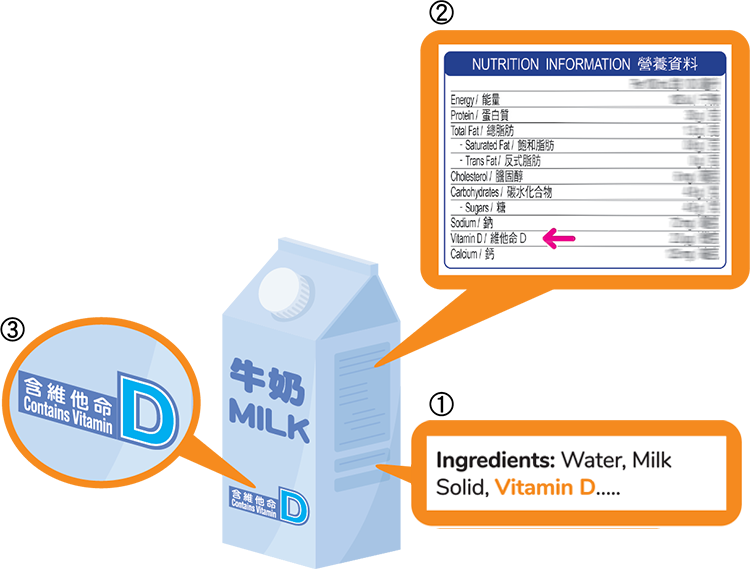
7. How do I know if a food product contains added vitamin D?
You can check the food label on the product package. Kindly note that:
- The list of ingredients should include vitamin D if it is added to the product;
- Some products would show the amount of vitamin D on the nutrition label;
- Some products would show nutrition claims about vitamin D on the packaging.
Reference:
- Chinese Nutrition Society. Dietary Reference Intakes for China (2023 edition)
- European Food Safety Authority (EFSA). (2018). Update of the tolerable upper intake level for vitamin D for infants, EFSA Journal, 16(8), 5365. https://doi.org/10.2903/j.efsa.2018.5365 Accessed on 24th June, 2025
- U.S. Department of Health and Human Services National Institutes of Health (NIH) Office of Dietary Supplements. (2023). Vitamin D fact sheet for health professionals. Retrieve from: https://ods.od.nih.gov/factsheets/VitaminD-HealthProfessional/ Accessed on 24th June, 2025
- The Nutrient Information Inquiry System, Centre for Food Safety, except the calcium content of calcium-fortified soy milk which comes from the packages of local calcium-fortified soymilk. Accessed on 23rd June, 2026
- Data from the USDA FoodData Central data (https://fdc.nal.usda.gov/) Accessed on 23rd June, 2026
- Data from the Health Promotion Board of Singapore (https://pphtpc.hpb.gov.sg/web/sgfoodid) Accessed on 23rd June, 2026
- Standard Tables of Food Composition in Japan - 2015 (https://www.mext.go.jp/en/policy/science_technology/policy/title01/detail01/1374030.htm) Accessed on 23rd June, 2026
- Information from the nutrition labels on local product packaging. Accessed on 23rd June, 2026